
LankaTrip जानकारी

37 मिनट पढ़ें

Renting a Tuk-Tuk or Scooter in Sri Lanka in 2026: The Complete Self-Drive, Permit and Safety Guide

Self-driving a tuk-tuk or scooter is the fastest-growing way foreign travelers explore Sri Lanka — but the licence rules confuse almost everyone, and most online guides are written by companies selling you the rental. Here is the independent 2026 version.

ब्लॉग पर वापस
Renting a Tuk-Tuk or Scooter in Sri Lanka in 2026: The Complete Self-Drive, Permit and Safety Guide

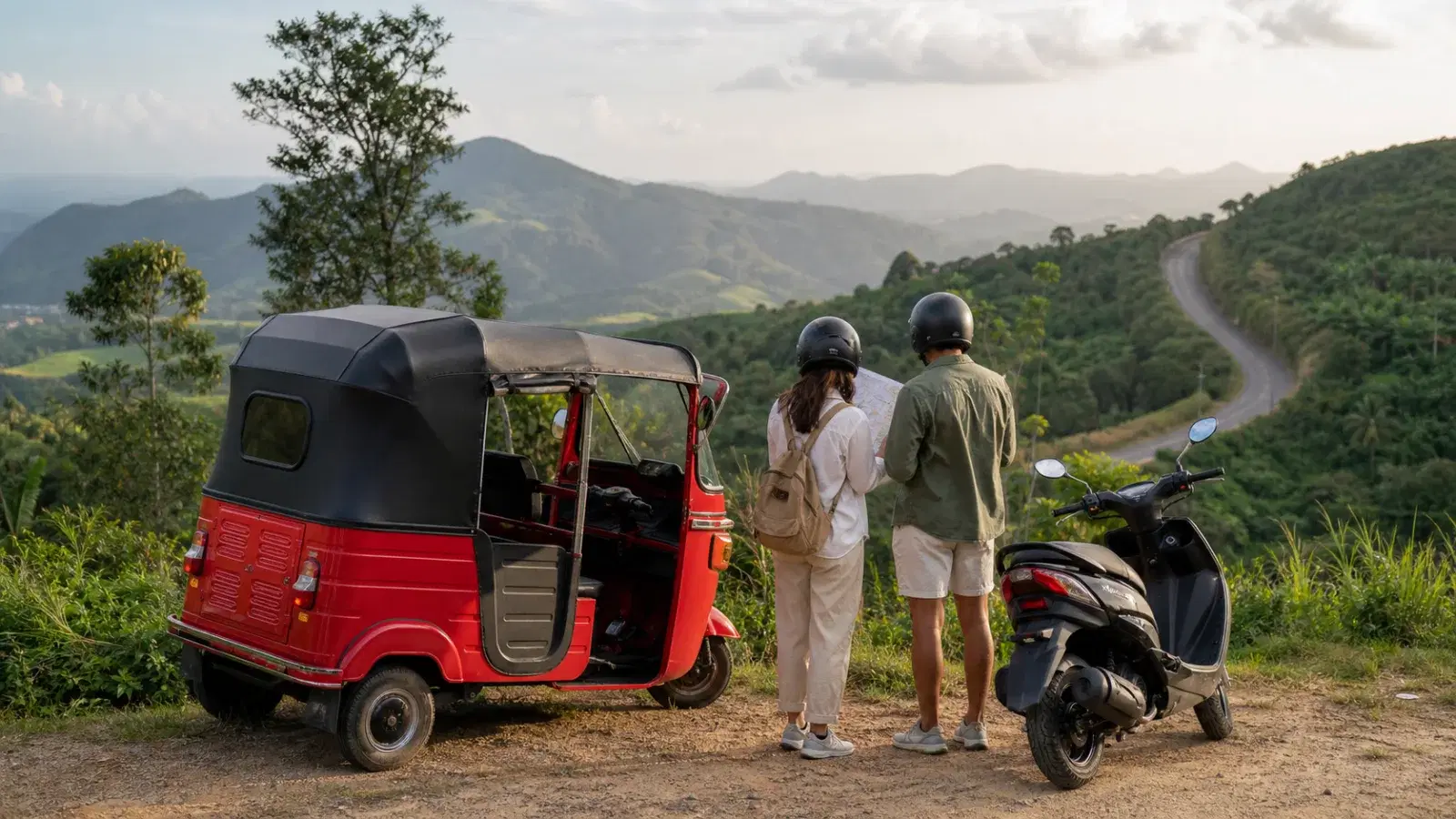
Something has changed in how people travel Sri Lanka. Ten years ago, almost every foreign visitor either hired a driver for their whole trip or moved between towns by train and bus. Today, on any given morning on the road between Ella and Wellawaya, you will pass foreign couples driving their own tuk-tuks, luggage strapped to the back, phone clipped to the windscreen frame.

The appeal is obvious. Sri Lanka is small — you can cross it in a day — but the good stuff is rarely at the bus stop. It is down an unmarked lane, past a tea factory, at a viewpoint with no name. A vehicle of your own turns a fixed itinerary into an open one.

The problem is that the information travelers find when they start researching is a mess. Search 'can I drive in Sri Lanka' and you will get a dozen confident, contradictory answers. One page says an International Driving Permit is all you need. Another says it is worthless. Fees are quoted at LKR 1,000 on one site and LKR 15,000 on another. Almost every one of those pages is published by a company that wants to rent you a vehicle.

This guide is written by people who are not renting you anything. LankaTrip connects travelers with licensed local guides; we do not operate a vehicle fleet, and we do not take a commission on tuk-tuk bookings. That means we can tell you the parts the rental blogs skip — including the situations where we think you should not self-drive at all.

What follows covers the legal position as plainly as we can state it, the three routes to getting a permit, honest 2026 costs, how to assess a rental company without us naming one, the insurance gap that could cost you a five-figure hospital bill, and what Sri Lankan roads genuinely feel like from behind a handlebar.

त्वरित सारांश

  • Your home licence and an International Driving Permit are NOT enough on their own — Sri Lanka requires a locally issued permit
  • Since August 2025 there is a Department of Motor Traffic counter in the arrivals hall at Bandaranaike International Airport, open around the clock
  • The airport permit covers cars, motorbikes and scooters — it does NOT cover tuk-tuks
  • Tuk-tuks are three-wheelers and need a separate endorsement, usually via the Automobile Association of Ceylon, which now requires an International Driving Permit first
  • Published permit fees contradict each other wildly online; budget flexibly and confirm at the counter
  • Expect roughly USD 10–22 per day for a tuk-tuk and USD 8–15 per day for a scooter in 2026, plus a refundable deposit
  • Most standard travel insurance policies exclude motorised-vehicle accidents unless you buy an add-on AND hold the correct licence
  • Sri Lankan police recorded over 1,200 road deaths in the first half of 2026 alone — motorcyclists are among the most vulnerable road users
  • Self-driving is superb for confident, experienced drivers and a poor idea for nervous or first-time riders

Why Self-Driving Has Taken Off in Sri Lanka

Sri Lanka is unusually well suited to independent driving. Distances are short, fuel is cheap by international standards, and the density of things worth stopping for is remarkable — a lagoon, a stupa, a roadside king coconut stand, a viewpoint over rice terraces, all within a few kilometres of each other.

The economics also make sense for longer trips. A private car with a driver typically runs somewhere in the region of USD 45 to 85 per day depending on the vehicle and route. A self-drive tuk-tuk sits closer to USD 10 to 22 per day. Over a three-week trip, that difference is substantial — often the cost of several nights' accommodation.

But cost is rarely the real reason people do it. The reason people do it is the stopping. When you have hired a driver, there is a quiet social pressure to keep moving; someone is waiting. When the vehicle is yours, you pull over because the light is good, and you stay for an hour.

The tuk-tuk in particular has become a kind of travel signature for Sri Lanka. It is slow, open-sided, faintly ridiculous, and utterly suited to the roads here — narrow enough for village lanes, cheap enough to run, and stable enough for two people with luggage.

None of which makes it the right choice for everyone. The next section is the one we would want to read first.

Short distances, dense sightseeingSignificantly cheaper than a private driverFreedom to stop without pressureTuk-tuks suit Sri Lankan road widthNot the right fit for every traveler

The Honest Question First: Should You Drive Here at All?

Most guides on this subject open by telling you how easy and fun self-driving is. We want to put the harder question first, because getting this wrong has consequences that no amount of good planning can undo.

Sri Lanka Police reported more than 1,200 road deaths in the first half of 2026 alone. Motorcyclists and pedestrians are consistently identified among the most vulnerable groups, and speeding is repeatedly cited as a leading cause. World Bank analysis has previously noted that Sri Lanka's road crash deaths per capita rank at the high end of the South Asian region, and that the large majority of victims are vulnerable road users rather than people inside cars.

This is not a reason to never drive here. It is a reason to be honest about your own experience level. Self-driving Sri Lanka suits you if you already ride a scooter or motorbike regularly at home, or drive confidently in dense, unpredictable traffic. It suits you if you are comfortable being overtaken on blind corners and staying calm about it.

It does not suit you if Sri Lanka would be the place you learn to ride. It does not suit you if you have never driven on the left. It is a poor idea if you are traveling with small children — a tuk-tuk has no seatbelts, no doors, and no crash structure. And it is a bad idea for anyone planning to drink at any point in the day, given both the legal position and the road environment.

A middle path exists and is underused: rent for part of your trip rather than all of it. Take a scooter for four days on the quiet southern coast between Tangalle and Dickwella, and hire a driver for the hill-country legs where the roads are steep, wet, and busy with buses. You get the freedom where it is most enjoyable and the safety where it matters most.

If after reading that you still want to drive, the rest of this guide is for you.

Over 1,200 road deaths in H1 2026Motorcyclists among most vulnerableNot the place to learn to rideTuk-tuks have no seatbelts or crash structureConsider renting for part of the trip only

The Licence Rules, Stated Plainly

Here is the single most important sentence in this guide: your home country driving licence, on its own, does not permit you to drive in Sri Lanka. Neither does an International Driving Permit on its own.

An International Driving Permit — IDP — is frequently misunderstood. It is not a licence. It is a standardised multilingual translation of the licence you already hold, issued by an authorised body in your home country. It has no independent legal force.

Sri Lanka requires foreign drivers to have their licence recognised locally before driving. That local document goes by a few names depending on who issues it — a temporary driving permit, a temporary driving licence, or a Recognition Permit (sometimes called a Covering Permit). Functionally, they serve the same purpose: they make your foreign licence valid on Sri Lankan roads.

There is one further layer that catches almost everyone out. Tuk-tuks are legally three-wheelers, a separate vehicle class from cars and motorcycles. A permit issued for light vehicles and motorbikes does not automatically cover you to drive a three-wheeler. Tuk-tuk drivers need a specific three-wheeler endorsement.

You will find travel forums and rental pages describing tuk-tuk licensing as a 'grey area' and noting that police rarely stop foreign-driven tuk-tuks in tourist areas. Whether or not that is true on any given day, it is bad advice to rely on. Enforcement is not the point — insurance is. We come back to that in detail below.

So: identify which vehicle class you want, then get the permit that actually covers it. The next three sections cover the three routes.

Home licence alone is not validAn IDP is a translation, not a licenceYou need a locally issued permitTuk-tuks are a separate vehicle classDo not rely on 'police rarely check'

Route 1: The Airport Permit Counter (Fastest for Cars and Scooters)

This is the biggest practical change for travelers in recent years. Since August 2025, the Department of Motor Traffic has operated a service counter in the arrivals area at Bandaranaike International Airport, near the Colombo entry point most visitors use. Multiple sources describe it as operating around the clock and located in the arrivals walkway close to the supermarket.

The significance is that you can land, clear immigration, and walk out with a valid Sri Lankan permit the same hour — no trip into Colombo, no waiting days, no advance paperwork.

What it covers: light vehicles, motorcycles and scooters. What it does not cover: three-wheelers, meaning tuk-tuks, and heavy or commercial vehicles. If a tuk-tuk is your plan, this counter alone will not solve your problem.

What to bring: your original full home-country driving licence, your passport, and your visa or entry approval. Passport-sized photographs are commonly requested, so bring two with a white background. Note that provisional, learner, probationary and temporary licences are consistently reported as not accepted — it must be a full licence, and it should have meaningful validity remaining.

If your licence is not in English, bring a certified English translation, or an IDP which serves that translation function. Do not assume a phone photo or an app translation will be accepted.

Payment is in Sri Lankan rupees. Card payment is generally accepted, but arriving with some rupees is sensible anyway. Validity periods are typically issued in monthly blocks up to a several-month maximum, tied to the validity of your visa.

One practical warning: this is a government counter, not a shop. Staffing, hours and fees can change without any announcement reaching the travel blogs. Treat everything you read online — including this page — as a strong indication rather than a guarantee, and be prepared to adapt.

Operating since August 2025 at BIA arrivalsReported as a 24-hour counterCovers cars, motorbikes and scootersDoes NOT cover tuk-tuksFull licence only — no learner permitsBring passport photos and rupees

Route 2: The Department of Motor Traffic Office

Before the airport counter existed, the standard route was to apply in person at a Department of Motor Traffic office, with the Werahera branch in the Boralesgamuwa area south of Colombo being the one most commonly referenced for foreign applicants.

This route still exists and remains relevant in two situations: if you did not sort your permit on arrival and are already in the country, or if you need to extend a permit that is about to expire.

The documentation is broadly the same as the airport counter — full home licence, passport, visa, photographs, and a certified translation if your licence is not in English. Several sources note the DMT route has historically been the cheaper of the options, though see the section below on why fee figures should be treated cautiously.

The trade-off is time. This is a government office serving the general public, not a tourist service point. Expect queues, expect to be sent between counters, and set aside most of a morning rather than an hour. Going early in the working week generally helps.

Getting there from central Colombo takes roughly 45 minutes to an hour depending on traffic. Using a ride-hailing app is straightforward. Bring a book.

If your Sri Lankan trip runs longer than your original permit, this is also where extensions are handled. Do not let a permit lapse quietly and keep driving — an expired permit puts you in the same position as no permit at all.

Werahera branch commonly used by foreignersUseful if you missed the airport counterHistorically the cheapest optionAllow most of a morningAlso handles permit extensions

Route 3: The AAC Recognition Permit (Required for Tuk-Tuks)

The Automobile Association of Ceylon, based in Colombo 03, issues what is usually called a Recognition Permit or Covering Permit. For travelers who want to drive a tuk-tuk, this is the route that matters, because the AAC permit can carry the three-wheeler endorsement that the airport counter does not provide.

There is a crucial procedural change to be aware of. Reporting from 2025 onward indicates that the AAC now requires applicants to hold a valid International Driving Permit before it will process a Recognition Permit. Previously you could walk in with only your home licence.

The practical consequence is significant and time-sensitive: you cannot obtain an IDP in Sri Lanka. It must be issued in your home country before you travel, and depending on your country that can take anywhere from same-day at an automobile association office to several weeks by post.

So if a tuk-tuk road trip is your plan, the very first action item is not booking a rental — it is getting an IDP at home, weeks in advance. This single step is the one most commonly discovered too late.

Processing at the AAC is generally reported as same-day, often within a few hours, with the permit's validity typically linked to your IDP and visa duration. Bring the physical IDP booklet, your home licence, passport, visa page and photographs.

Many rental operators offer to arrange this permit on your behalf for a handling fee, using scanned documents sent ahead of your arrival so the permit is waiting when you land. That convenience is genuinely useful, and it is also where a meaningful markup often sits. Ask for the fee to be itemised separately from the rental rate so you can see what you are paying for the service versus the permit itself.

Required route for tuk-tuk driversNow requires an IDP firstIDP cannot be obtained inside Sri LankaGet your IDP weeks before flyingOften same-day processing in ColomboAsk rentals to itemise the handling fee

Why Every Website Quotes You a Different Fee

If you have already researched this topic, you will have noticed that permit costs quoted online range from around LKR 1,000 to LKR 15,000 — a spread of more than tenfold. We looked at this carefully because it is the single most confusing part of the process, and we think travelers deserve an explanation rather than another confident number.

There appear to be several overlapping reasons for the divergence. First, the different routes genuinely cost different amounts: a basic short-validity permit from a government office is not the same product as a longer-validity Recognition Permit with a three-wheeler endorsement.

Second, validity period drives price. A permit issued for one month and a permit issued for several months are not comparable figures, but they are frequently quoted side by side as if they were.

Third — and this is the part rarely acknowledged — many quoted 'permit costs' are actually a rental company's bundled service charge, which includes their handling fee. A page quoting USD 40 for a 'permit' may be quoting the price of a service, not a government fee.

Fourth, fees have changed more than once in recent years, and older articles stay indexed on Google long after the numbers stop being true. An article confidently quoting a 2024 figure will look identical in search results to one quoting a 2026 figure.

Our honest advice: budget somewhere in the region of LKR 2,000 to LKR 15,000 depending on which route and validity you need, treat any single figure you read as unverified, and confirm the actual amount at the counter or with the AAC directly. If a rental company quotes a permit cost, ask specifically whether that is the government fee or their all-in service price.

We would rather tell you the number is uncertain than give you a precise figure we cannot stand behind.

Quoted fees vary more than tenfold onlineDifferent routes are genuinely different productsValidity period changes the priceMany quotes bundle a service markupOld articles stay indexed with stale figuresConfirm directly rather than trusting any page

Tuk-Tuk, Scooter, Motorbike or Car: Choosing Honestly

The tuk-tuk is the romantic choice and, for many trips, the practical one. It carries two people plus real luggage, it is stable at the low speeds Sri Lankan roads demand, it is open-sided so you actually see the country, and it does not require riding experience in the way a motorbike does. The trade-offs: it is slow, averaging perhaps 40 to 60 km/h on good roads and considerably less in the hills; it tips more easily than people expect on fast corners; and it offers no shelter from heavy rain.

A scooter of around 100 to 125cc is the choice for coastal hopping. If your trip is based in one area — the south coast between Weligama and Tangalle, or around Arugam Bay — a scooter is cheap, easy to park and quick for short hops. It is a poor choice for long-distance touring with luggage or for two adults plus bags.

A motorbike in the 125 to 250cc range suits experienced riders covering longer distances or planning serious hill-country routes, where a scooter's small wheels and limited power become a genuine safety issue on steep, wet descents.

A self-drive car makes sense for families, for travel during monsoon months, and for anyone who wants air conditioning and a locked boot. It is the safest option by a wide margin. It is also the most stressful to drive in Sri Lankan traffic, because a car is wide for these roads and you will spend a lot of time deciding whether an overtaking bus is going to make it.

One consideration that surprises people: luggage. Two travelers with large backpacks will struggle on a scooter and be comfortable in a tuk-tuk. If your bags are big, that alone may settle the decision.

A useful rule of thumb — pick the vehicle that matches your least confident travel companion, not your most confident one.

Tuk-tuk: best all-round for two with luggageScooter: best for coastal short hopsMotorbike: for experienced riders and hillsCar: safest, best for families and monsoonLuggage size often decides itMatch the least confident traveler

What You Will Actually Pay in 2026

Daily rental rates in 2026 sit in reasonably consistent bands, though they move with season, duration and operator quality. Longer rentals almost always reduce the daily rate.

Tuk-tuks generally run from around USD 10 to USD 22 per day, with the lower end typically reflecting smaller local operators or long rental periods, and the upper end reflecting larger companies with fuller support networks.

Scooters of 100 to 125cc typically fall around USD 8 to USD 15 per day. Small motorcycles of 125 to 150cc run roughly USD 15 to USD 25. Larger touring bikes and premium classic models can reach USD 35 to USD 50.

Security deposits are standard and typically range from around USD 50 to USD 150, refunded on undamaged return. A small number of operators advertise zero-deposit terms, usually paired with a fixed insurance charge instead.

Fuel is one of the genuine pleasures of driving here. A tuk-tuk returns roughly 25 to 35 kilometres per litre, which works out to only a few dollars per hundred kilometres. Petrol prices are government-regulated and have sat broadly in the LKR 350 to 400 per litre range for 92 octane in recent reporting, though this moves with global prices and policy.

Budget separately for the permit, any handling fee, insurance upgrades, and a contingency for minor damage. A realistic all-in figure for two people on a two-week tuk-tuk trip, excluding accommodation and food, tends to land somewhere around USD 300 to USD 450 once everything is counted.

A note on suspiciously cheap deals. A rate well below the ranges above usually means something has been removed — maintenance, insurance, or support when you break down 200 kilometres from the depot. That saving evaporates the first time something goes wrong.

Tuk-tuk: roughly USD 10–22 per dayScooter: roughly USD 8–15 per dayDeposits typically USD 50–150Tuk-tuks return 25–35 km per litreBudget USD 300–450 for two weeks, two peopleVery cheap rates usually mean missing insurance

How to Choose a Rental Company (Without Us Naming One)

We have a standing editorial policy on this site: we do not name or endorse specific businesses. It would be easy to list three rental companies here, and several of them run affiliate programmes that would pay us for doing so. That is precisely why we do not. Instead, here is the checklist we would use ourselves.

Check the vehicle documents before anything else. A legally rentable vehicle should have current registration, a valid revenue licence, and an insurance certificate. Ask to see them. Photograph them. If police stop you, you will need them, and a company that hesitates at this request is telling you something.

Insist on a written rental agreement in English that specifies what the insurance actually covers, what your liability is in an accident, whether kilometres are unlimited, and the exact terms for deposit return. Verbal assurances are worth nothing when there is a dispute.

Do a proper handover inspection and film it. Walk around the vehicle recording video, narrating existing damage aloud. Check tyre tread, brakes, lights, indicators and horn — the horn genuinely matters here. This five-minute recording is your best protection against a damage claim at drop-off.

Ask what happens when you break down 150 kilometres away at 7pm. A serious operator will describe an actual process: a phone number, a partner mechanic network, a replacement-vehicle policy. A vague answer means you will be solving that problem yourself.

Ask whether a driving lesson is included. Good tuk-tuk operators include a hands-on session before you leave, and you should take it even if you feel confident. The controls are not intuitive if you have never used them.

Read recent reviews rather than overall ratings, and read the negative ones specifically. Look for patterns in how disputes were handled — that tells you far more than a star average.

Finally, confirm in writing who arranges the permit and what it covers. If you are renting a tuk-tuk, confirm explicitly that the permit includes the three-wheeler endorsement.

Ask to see registration and insuranceGet a written English agreementFilm the handover inspectionTest the horn, brakes and lightsAsk about breakdown support specificallyConfirm the permit covers three-wheelers

The Insurance Gap Almost Nobody Warns You About

This is the section we would most want a friend to read before renting anything in Sri Lanka, and it is the one most consistently missing from pages published by rental companies.

There are two entirely separate insurances at play, and travelers routinely confuse them. The first is vehicle insurance, provided with the rental. This typically covers damage to the vehicle and some third-party liability. The second is your own travel insurance, which covers your medical treatment, hospital care, and repatriation if you are injured.

Here is the trap. A very large number of standard travel insurance policies exclude injuries sustained while riding or driving a motorised vehicle, unless you have purchased a specific motorcycle, moped or vehicle-use add-on. Many policies that do include such cover attach a condition: you must have been legally licensed to operate that vehicle in the country where the accident occurred, and you must have been wearing a helmet where required.

Put those two facts together and the picture becomes serious. If you drive a tuk-tuk on a permit that does not carry a three-wheeler endorsement and you are badly injured, your insurer has a straightforward reason to decline the claim. Medical evacuation from Sri Lanka to Europe, North America or Australia can run well into five figures.

This is the real reason we said earlier not to rely on 'police rarely check tuk-tuks'. Police enforcement is not the risk you are managing. The insurance company reading your claim file afterwards is.

What to do, concretely: read your policy's exclusions section before you travel, not after. Search the document for the words 'motorcycle', 'moped', 'motorised' and 'licensed'. If you find an exclusion, contact your insurer and buy the appropriate add-on. Ask them directly, in writing, whether a three-wheeler counts as a motorcycle under their terms — the answer varies between insurers and is worth having on record.

Then make sure the permit you hold actually matches the vehicle you drive. That single alignment is what makes the rest of the policy work.

Rental insurance and travel insurance are separateMany policies exclude motorised vehicles by defaultCover often requires being legally licensedMedical evacuation can cost five figuresSearch your policy for 'motorcycle' and 'licensed'Ask in writing if three-wheelers are covered

What Sri Lankan Roads Are Actually Like

Sri Lankan traffic has a logic, but it is not the logic of European or North American roads. Understanding it before you set off is worth more than any amount of general driving confidence.

The hierarchy is real and unwritten. Buses are at the top. Intercity buses in particular drive to a schedule they intend to keep, and they will overtake into oncoming traffic expecting everyone else to make room. The correct response is to make room. This is not a battle to win on principle.

The horn is communication, not aggression. A short beep means 'I am here, behind you and to your right'. It is used constantly and it is genuinely useful. Use yours the same way — before blind corners, when overtaking, when approaching a pedestrian who has not seen you.

Lane markings are advisory. Vehicles occupy the space that is available. Expect to be overtaken on both sides, expect motorbikes to filter past you at junctions, and expect the oncoming lane to be in use by someone overtaking.

The unexpected obstacle is the defining feature of rural driving. Dogs asleep on warm tarmac, cattle, monitor lizards, school children, a bus stopped mid-lane, a truck unloading. Speed control matters more than any other skill, because everything is survivable at 40 km/h.

Hill-country roads deserve specific respect. The routes around Nuwara Eliya, Ella, Haputale and the Knuckles region are steep, tight, frequently wet, and often shrouded in mist by mid-afternoon. Descents put sustained load on brakes that may not be in perfect condition. Drive these in the morning, and drive them slowly.

Expressways are a different world entirely — modern, well-surfaced, with proper lane discipline and speed cameras. They are also generally closed to three-wheelers and low-capacity motorcycles, so tuk-tuk and small-scooter drivers will be on the older main roads regardless. Factor that into your travel time estimates.

Night driving is the one thing we would advise against almost universally. Unlit roads, unlit pedestrians, unlit bicycles, oncoming full beams and animals combine into a risk profile that no view is worth. Plan to be parked by dusk.

Buses have de facto priority — yieldThe horn is communication, not aggressionLane markings are advisoryAnimals and pedestrians appear without warningHill roads: drive in the morning, slowlyExpressways usually exclude tuk-tuksDo not drive after dark

Rules, Speed Limits and Police Checkpoints

Sri Lanka drives on the left, a legacy of the colonial period. Overtaking is on the right. At roundabouts, give way to traffic already circulating from your right. If you are coming from a right-hand-drive country this will feel natural; if not, the first hour is the hardest and junctions are where mistakes happen.

Speed limits as commonly published for 2026 are 50 km/h in built-up areas, 70 km/h on open rural roads, and 100 km/h on expressways with reduced limits on entry and exit ramps. Posted signage always overrides these defaults. Speed cameras operate on expressways.

Helmets are legally required for riders and passengers on motorcycles and scooters, and enforcement of this is taken seriously. Beyond the legal position, it is the single highest-value safety decision you will make. If the helmet supplied with your rental is cracked, loose or missing its strap, ask for another one or buy your own — decent helmets are widely available and inexpensive relative to the alternative.

Drink driving is treated seriously and there is no reason to test it. Sri Lanka also has nationwide alcohol restrictions on Poya (full moon) days, when licensed premises and liquor outlets close — which is worth knowing for trip planning generally.

Mobile phone use while driving is prohibited. Mount your phone if you are navigating; do not hold it.

Police checkpoints are common, particularly on main routes and around towns. Being stopped is routine and is not cause for alarm. Officers will typically want to see your permit, the vehicle's registration and insurance documents, and sometimes your passport. Keep documents accessible but not loose, and keep photographed copies on your phone as a backup.

Be polite and unhurried at checkpoints. In the vast majority of cases you will be waved on within a minute. If you are issued a fine, ask for an official receipt — the existence of a proper receipt is what distinguishes a legitimate penalty from something else.

Carry your documents at all times rather than leaving them at your accommodation. A permit in a hotel safe is a permit you do not have.

Drive on the left, overtake on the right50 / 70 / 100 km/h general limitsHelmets are mandatory and enforcedNo alcohol, no handheld phone useCheckpoints are routine — stay politeAlways ask for an official receiptCarry documents, don't leave them behind

A Defensive Driving Playbook for Sri Lanka

These are the habits that experienced drivers here develop, condensed so you do not have to learn them the expensive way.

Drive slower than you think necessary for the first two days. Almost every incident involving foreign drivers happens in the early phase, before the traffic rhythm makes sense. Give yourself a deliberate adjustment period on quiet roads.

Assume you have not been seen. Treat every side road, every driveway and every pedestrian as though they are about to move into your path, because sometimes they will.

Leave a following distance that feels excessive. Braking distances on worn tyres and wet tarmac are longer than you expect, and the vehicle in front may stop for something you cannot see.

Never overtake on a blind corner or a crest, however normal it looks when locals do it. They know the road. You do not.

Take corners in the hills wider and slower than feels natural. Tuk-tuks in particular become unstable at speed on tight bends, and the consequence of a slide on a mountain road is different from the consequence on a flat one.

Plan short driving days. A hundred kilometres is a comfortable day in a tuk-tuk. Two hundred is an endurance exercise that leaves you tired at exactly the point when tiredness matters most. Under-plan distance and over-plan stops.

Check the weather before hill-country legs. Heavy rain transforms mountain roads, reduces visibility to metres, and makes drainage channels at the roadside genuinely dangerous.

Stop when you are tired, frustrated or rattled. Pull over, buy a tea, wait twenty minutes. Almost all bad driving decisions come after a period of building stress.

Wear real shoes, not flip-flops. Foot injuries from minor incidents are common and entirely preventable.

Go slowly for the first two daysAssume you have not been seenNever overtake blindPlan around 100 km driving daysCheck weather before hill legsStop when tired or stressedWear proper shoes, not sandals

The Best Self-Drive Routes — and the Ones to Skip

Not all of Sri Lanka rewards self-driving equally. Some stretches are among the finest driving roads in South Asia; others are simply unpleasant traffic you have paid for the privilege of sitting in.

The southern coastal run from Weligama through Mirissa, Dickwella and Tangalle toward Hambantota is the ideal beginner route. The roads are wide by local standards, the traffic is moderate, distances between stops are short, and the scenery is continuous. This is where we would suggest anyone start.

The Ella to Wellawaya descent via the Ravana Falls area is spectacular and technically demanding, dropping sharply through a series of tight bends. Do it in the morning in clear weather and take your time. It is the drive that convinces people the whole exercise was worth it.

The route between Ella, Haputale and the Lipton's Seat area passes through the tea country at its most photogenic, on narrow estate roads with almost no traffic. Mist arrives early in the afternoon here, so start early.

The east coast around Arugam Bay, Pottuvil and the Panama road is quiet, flat and genuinely relaxing, particularly during the east coast season from roughly May to September when the south is wet.

The Cultural Triangle roads between Sigiriya, Dambulla, Habarana and Polonnaruwa are flat, well-surfaced and easy, with the caveat that this is wild elephant country. Elephants do cross these roads, particularly at dawn and dusk, and an encounter in a tuk-tuk is not a photo opportunity — it is a situation to reverse away from calmly and slowly.

The route we would suggest skipping is Colombo itself. Driving into central Colombo as a visitor is a poor use of a rental — dense traffic, difficult parking, and a city genuinely well served by ride-hailing apps. Most travelers are better off collecting their vehicle in Negombo, which sits close to the airport with far calmer roads, and leaving Colombo to taxis.

One planning note relevant in 2026: the main railway line remains disrupted between Rambukkana and Nanu Oya following Cyclone Ditwah, with trains currently running Colombo to Rambukkana and Nanu Oya through to Ella and Badulla. That closure has pushed more traffic onto the parallel roads through the central hills, so allow extra time on those legs.

South coast: best beginner routeElla to Wellawaya: spectacular and demandingHaputale tea roads: start early before mistEast coast: quiet, May to SeptemberCultural Triangle: watch for wild elephantsSkip driving into central ColomboHill roads busier due to rail closure

Fuel, Breakdowns and Navigation

Fuel stations are frequent along main routes and in towns, operated mainly by the state petroleum corporation and one major private operator. In the Northern Province, remote east coast stretches and deep rural areas, gaps between stations widen considerably. The simple discipline is to refuel whenever you drop below half a tank outside a town.

Carry cash for fuel. Card acceptance is normal in urban stations and unreliable in rural ones.

Note that Sri Lanka has at times operated a national fuel pass system requiring QR registration during supply disruptions. Whether it is active during your visit varies; ask your rental company at handover whether anything applies to your vehicle, since as a foreign visitor you will generally be relying on them to have this sorted.

Breakdowns are part of the experience rather than a disaster. Sri Lanka has an extraordinary density of small roadside mechanics, and tuk-tuks in particular are simple machines that local workshops can fix quickly and cheaply. A puncture or a minor electrical fault is usually an hour and a modest sum.

Before you leave the depot, save your rental company's WhatsApp number, confirm they have a mechanic network, and ask what they want you to do rather than improvising. Some operators prefer to dispatch their own person; others are happy for you to use any local workshop and reimburse.

For navigation, download offline maps for the whole island before you travel. Mobile coverage is broadly good on populated routes but drops in the hills and forest areas exactly when you least want it to. Mount your phone properly — holding it is both illegal and impractical.

Be moderately sceptical of routing apps in rural Sri Lanka. They will occasionally send you down a track that is technically a road and practically a footpath. If a suggested route looks implausibly narrow or steep, take the longer main road instead.

Finally, carry water, a basic first aid kit, a phone power bank, and a light rain layer. All four get used.

Refuel below half a tank outside townsCarry cash — rural card acceptance is patchyAsk about any fuel pass requirementsRoadside mechanics are everywhere and cheapSave the rental WhatsApp numberDownload offline maps before you goDon't blindly trust rural app routing

If You Have an Accident: What to Do

Nobody wants to read this section and everybody should. Having a clear sequence in your head means you act sensibly in the minutes when clear thinking is hardest.

First, move to safety if you can and check for injuries — yours, your passengers', and anyone else's. Emergency numbers to save in your phone before you drive: 1990 for ambulance, 119 for police, and 1912 for the Tourist Police.

If anyone is injured, call for medical help before dealing with anything about the vehicle. Sri Lanka's ambulance service covers the country and government hospital emergency care is generally accessible; your travel insurer will handle the financial side afterwards if your policy is in order.

Do not move the vehicles if there has been a significant collision, unless they are creating an immediate hazard. Police will want to see the positions.

Photograph everything before anything moves — vehicle positions, damage on all vehicles, the road, any skid marks, road signs, and the other party's registration plate. Photograph their documents if they will allow it.

Call your rental company immediately. They deal with this regularly, they know the local process, and their involvement matters for any insurance claim on the vehicle.

Call your travel insurer's emergency line the same day, even if injuries seem minor. Many policies require prompt notification and late reporting is a common reason claims are reduced or refused.

Get a police report. For any insurance claim of substance, this is not optional. Ask for the reference number and photograph any document you are given.

A word on the emotional dimension: crowds gather quickly at accident scenes in Sri Lanka, which can feel intimidating but is usually curiosity and concern rather than hostility. Stay calm, stay polite, do not accept or assign blame at the roadside, and wait for police. Admissions made in a stressful moment can complicate everything that follows.

Save 1990, 119 and 1912 before drivingCheck injuries before anything elseDo not move vehicles after a serious collisionPhotograph everything immediatelyNotify rental company and insurer same dayAlways obtain a police reportDo not admit or assign blame roadside

If Self-Driving Is Not Right for You

Deciding against self-driving is a perfectly good outcome of reading this guide, and Sri Lanka remains one of the easier countries in Asia to travel without your own vehicle.

Hiring a car with a driver is the most common alternative and is better than it sounds. A good driver is a de facto guide who knows road conditions, weather patterns and where to stop. Rates commonly sit somewhere around USD 45 to 85 per day depending on vehicle and distance, typically including the driver's own accommodation and meals. Split between three or four people this becomes very reasonable.

Ride-hailing apps operate well in Colombo, Negombo, Kandy, Galle and other larger towns, covering both cars and tuk-tuks with metered pricing that removes fare negotiation entirely. For short hops within a town this is almost always the easiest option.

Trains remain one of the great experiences of Sri Lankan travel, with the caveat that the main line is currently disrupted between Rambukkana and Nanu Oya after Cyclone Ditwah, with reopening anticipated around January 2027. The Nanu Oya to Ella and Badulla section — the most scenic stretch of the whole line — is running normally.

Long-distance buses are inexpensive, frequent and go everywhere, though they are not comfortable and the driving style is not for the nervous.

A hybrid approach is what many experienced travelers settle on: a driver for long transfers between regions, and a locally rented tuk-tuk or scooter for a few days once you are based somewhere. You get the freedom without the fatigue, and you avoid driving the hardest roads on the island.

Driver-guide: roughly USD 45–85 per dayRide-hailing apps work well in larger townsNanu Oya to Ella rail section running normallyBuses are cheap, frequent and uncomfortableHybrid approach suits most travelers

Driving Responsibly as a Visitor

A rented tuk-tuk is a slightly odd object in Sri Lanka. For almost everyone else on the road, it is a working vehicle — a livelihood, a school run, a delivery. For you it is a holiday. That asymmetry is worth holding in mind.

Drive as a guest. Yield readily, do not block narrow village roads to take photographs, and pull fully off the carriageway when you stop. A vehicle parked half in the lane at a viewpoint creates real danger on a blind mountain bend.

Be considerate around working tuk-tuk drivers. Foreign self-drive rentals have grown quickly, and in some tourist areas that has meant a little less work for local drivers. Balancing that out costs nothing: use local drivers for airport transfers and evening trips, eat at local establishments, and buy fuel and repairs from small local workshops rather than only chain outlets.

Respect wildlife absolutely. Do not stop to photograph wild elephants from a tuk-tuk, do not approach them, and never position yourself between an elephant and its herd. Human-elephant conflict is a serious issue in Sri Lanka and tourist behaviour has contributed to incidents. Reverse away slowly and leave.

Ask before photographing people, homes, tea workers or religious sites. The freedom a vehicle gives you to reach quiet places also means you arrive somewhere nobody expected a visitor.

Take your rubbish with you. Roadside dumping is a visible problem and there is no reason for visitors to add to it.

And drive at a speed that would be acceptable if a child stepped out. In residential and village stretches, that is considerably slower than the posted limit.

Yield readily and drive as a guestNever block narrow roads for photosSupport local drivers and workshopsNever approach wild elephantsAsk before photographing peopleCarry your rubbish outSlow right down through villages

यात्रा सुझाव

  • Get your International Driving Permit at home weeks before you fly — you cannot obtain one in Sri Lanka and the AAC now requires it
  • Sort your permit at the airport arrivals counter on landing if you plan to drive a car, scooter or motorbike
  • Remember the airport permit does not cover tuk-tuks — three-wheelers need a separate endorsement
  • Bring two passport photographs with a white background and a certified English translation if your licence is not in English
  • Read your travel insurance exclusions before you travel and buy a motorised-vehicle add-on if needed
  • Film a full walk-around video of the vehicle at handover, narrating existing damage
  • Photograph the vehicle's registration and insurance documents and keep copies on your phone
  • Save 1990 (ambulance), 119 (police) and 1912 (Tourist Police) before you start driving
  • Never drive after dark — unlit pedestrians, animals and oncoming full beams make it genuinely dangerous
  • Plan around 100 km driving days in a tuk-tuk, not 200
  • Refuel whenever you fall below half a tank outside towns, and carry cash for fuel
  • Wear a properly fitting helmet on any two-wheeler and replace a damaged one immediately
  • Download offline maps for the whole island before arrival
  • Wear closed shoes rather than sandals whenever you drive
  • Collect your vehicle in Negombo rather than central Colombo for a much calmer start
  • Start hill-country legs early in the morning before afternoon mist and rain arrive

अक्सर पूछे जाने वाले प्रश्न

Can I drive in Sri Lanka with just my home country driving licence?

No. Your home licence alone does not authorise you to drive in Sri Lanka. You need a locally issued temporary driving permit or Recognition Permit that validates your foreign licence. Driving without one risks fines, vehicle impoundment, and your travel insurance declining any accident claim.

Is an International Driving Permit enough on its own?

No. An IDP is a standardised translation of your existing licence, not a licence in itself. It has no independent legal force in Sri Lanka. However, it is required by the Automobile Association of Ceylon before they will issue a Recognition Permit, so it matters a great deal if you want to drive a tuk-tuk.

Where do I get a driving permit when I arrive?

Since August 2025 the Department of Motor Traffic has operated a counter in the arrivals area at Bandaranaike International Airport, widely reported as open around the clock. It issues permits for cars, motorbikes and scooters. You can also apply at a DMT office, or at the Automobile Association of Ceylon in Colombo for a Recognition Permit.

Does the airport permit let me drive a tuk-tuk?

No. The airport counter permit covers light vehicles and motorcycles, not three-wheelers. Tuk-tuks are a separate vehicle class and require a specific three-wheeler endorsement, generally obtained through the Automobile Association of Ceylon.

How much does a Sri Lankan driving permit cost?

Published figures vary enormously, from around LKR 1,000 to LKR 15,000, because different routes, validity periods and bundled service fees are all quoted as if they were the same thing. Budget flexibly within that range and confirm the actual amount at the counter or with the issuing body rather than relying on any figure published online, including ours.

How much does it cost to rent a tuk-tuk in Sri Lanka in 2026?

Expect roughly USD 10 to 22 per day, with longer rentals reducing the daily rate. A refundable security deposit of around USD 50 to 150 is standard. Add the permit, any handling fee, fuel and insurance to get a realistic total.

Is it safe to drive in Sri Lanka as a tourist?

It depends heavily on your experience. Sri Lanka Police recorded over 1,200 road deaths in the first half of 2026, and motorcyclists are among the most vulnerable groups. Confident, experienced drivers who go slowly, avoid night driving and respect hill roads generally manage well. It is not a suitable place to learn to ride.

Will my travel insurance cover me if I crash a scooter or tuk-tuk?

Often not by default. Many standard policies exclude motorised vehicle use unless you purchase a specific add-on, and cover frequently requires that you were legally licensed for that vehicle class and wearing a helmet. Read your exclusions before travelling and confirm in writing with your insurer whether three-wheelers are covered.

What is the minimum age to rent a tuk-tuk or scooter?

Most rental companies require drivers to be at least 21, with some requiring 23 or older for larger motorcycles. Your licence generally also needs to have been held for at least one year. Requirements vary by operator, so confirm before booking.

Can tuk-tuks use the expressways?

Generally no. Three-wheelers and low-capacity motorcycles are typically excluded from Sri Lanka's expressways, so you will be travelling on older main roads. Build significantly more time into your route planning than an expressway estimate would suggest.

What happens at a police checkpoint?

Checkpoints are routine on main routes. Officers will typically ask to see your driving permit and the vehicle's registration and insurance documents, and sometimes your passport. Be polite and unhurried, keep documents accessible, and if you are fined, always request an official receipt.

Should I drive in Colombo?

We would suggest not. Central Colombo has dense traffic and difficult parking, and it is well served by ride-hailing apps. Collecting your vehicle in Negombo, which is close to the airport with much calmer roads, gives you a far easier start.

How far can I realistically drive in a day?

Around 100 km is a comfortable day in a tuk-tuk, given average speeds of roughly 40 to 60 km/h on good roads and considerably less in the hills. Two hundred kilometres is achievable but tiring, and fatigue is a genuine safety factor.

What should I do if I break down?

Contact your rental company first via the WhatsApp number you saved at handover. Sri Lanka has a dense network of small roadside mechanics and tuk-tuks in particular are simple to repair quickly and cheaply. Ask your operator whether they want to dispatch someone or are happy for you to use a local workshop.

Is self-driving suitable for families with young children?

A tuk-tuk or scooter is not, as neither offers seatbelts, doors or crash protection. Families who want to self-drive are much better served by a car, and many find hiring a car with a driver the most practical and safest option in Sri Lanka.

पाठक टिप्पणियां

बातचीत में शामिल हों

इस गाइड के लिए अपना प्रश्न, सुझाव या यात्रा अनुभव साझा करें.

टिप्पणियां

0 टिप्पणियां

लोड हो रहा है...

प्रेरणा को श्रीलंका यात्रा में बदलने के लिए तैयार हैं?

अपनी यात्रा की योजना बनाने, स्थानीय गाइड से जुड़ने और इस यात्रा कार्यक्रम को साकार करने के लिए LankaTrip का उपयोग करें.

योजना में मदद चाहिए?

अपनी श्रीलंका यात्रा की योजना बनाएं

मेरी यात्रा बनाएं