
Ask most first-time visitors to sketch a Sri Lanka itinerary and you will get the same loop: Colombo, the Cultural Triangle, the hill country, then down to the southern beaches. It is a superb route. It is also, from roughly May to September, a route that ends with a week of rain on a grey beach in Mirissa.
This is the single most useful thing to understand about Sri Lankan geography. The island runs two opposing monsoons. When the southwest is wet, the east is dry. When the east is wet, the southwest is glorious. A country that appears to have a bad half of the year actually has a good one all year round — you simply have to move to the right coast.
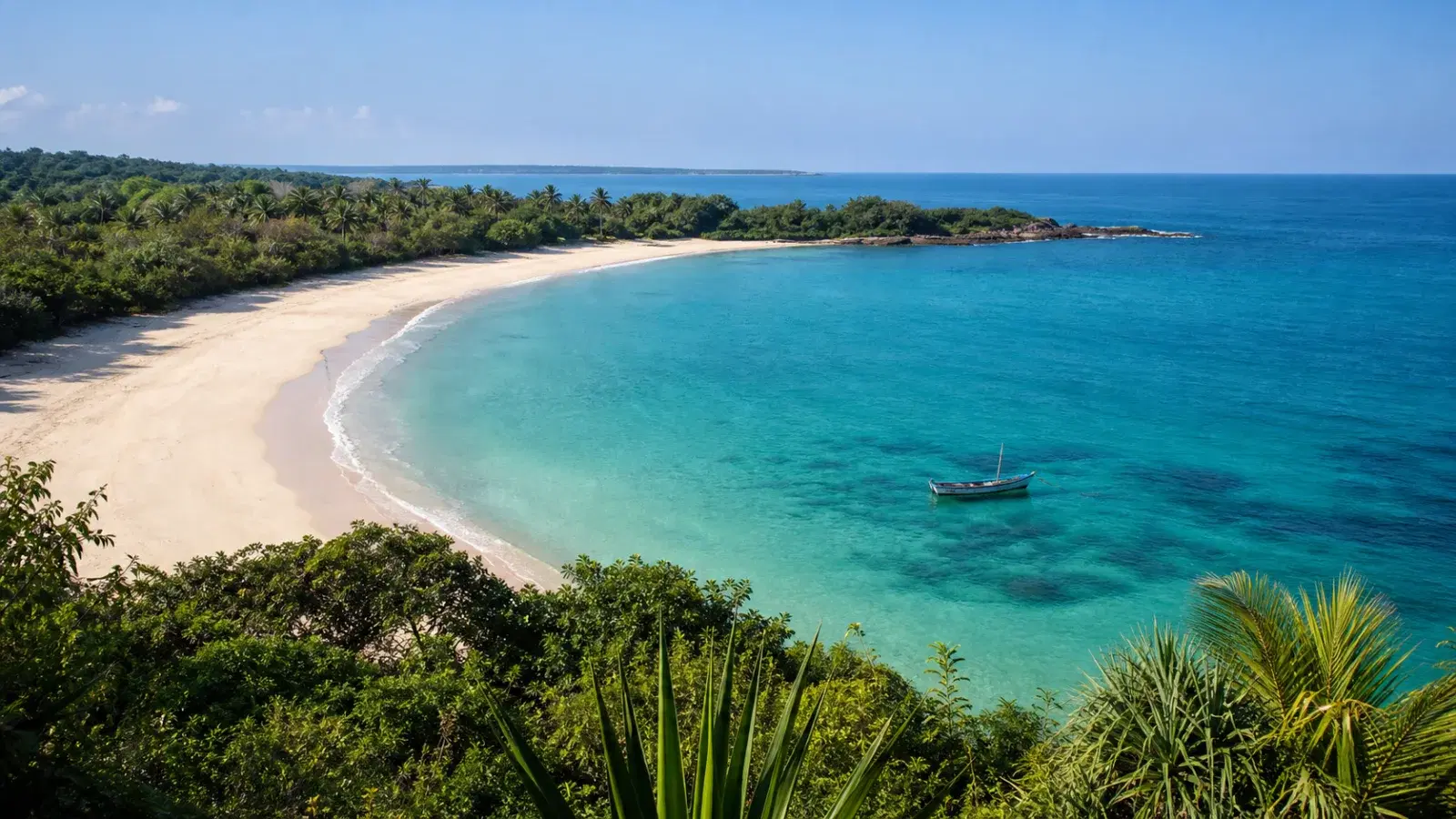
The east coast is where you go between May and September, and it is startlingly underused. Trincomalee, Uppuveli, Nilaveli, Pasikuda, Kalkudah and Batticaloa collectively receive a small fraction of the visitors the south sees. The water is calmer, the sand is whiter, the prices are lower, and there is no line for anything.
There is a reason for that under-visiting, and it is not that the beaches are inferior. The east was the region worst affected by the civil war that ended in 2009 and was devastated by the 2004 tsunami. Tourism infrastructure here restarted from close to zero, and the region has spent the years since rebuilding while the south collected the guidebook coverage.
There is also a practical bonus in 2026. Cyclone Ditwah damage has kept the famous hill-country railway between Rambukkana and Nanu Oya out of service, with reopening anticipated around January 2027. The eastern line, which branches away well before the damaged section, is running normally — so the east is currently one of the easiest regions in the country to reach by train.
This guide covers the whole coast from Trincomalee down to Batticaloa: when to come, how to get there, what each town is actually like, and the cultural context that makes travelling here different from the south.
त्वरित सारांश
- The east is dry and sunny from roughly May to September, exactly when the south is wettest
- Trincomalee sits on one of the largest natural harbours in the world
- Pigeon Island offers Sri Lanka's most accessible coral snorkelling, though it suffers from crowding
- Pasikuda has the shallowest, calmest swimming water on the island — ideal for young children
- Batticaloa is a lagoon city with a Dutch fort and a genuine local atmosphere, and sees very few foreign visitors
- The eastern railway line to Trincomalee and Batticaloa is running normally in 2026, unlike the hill-country main line
- Batticaloa-line timetables were revised in 2025 with night speed limits to reduce elephant collisions
- This is a culturally Tamil and Muslim majority region with a different feel from the south
- Prices are lower and crowds are far thinner than the south coast