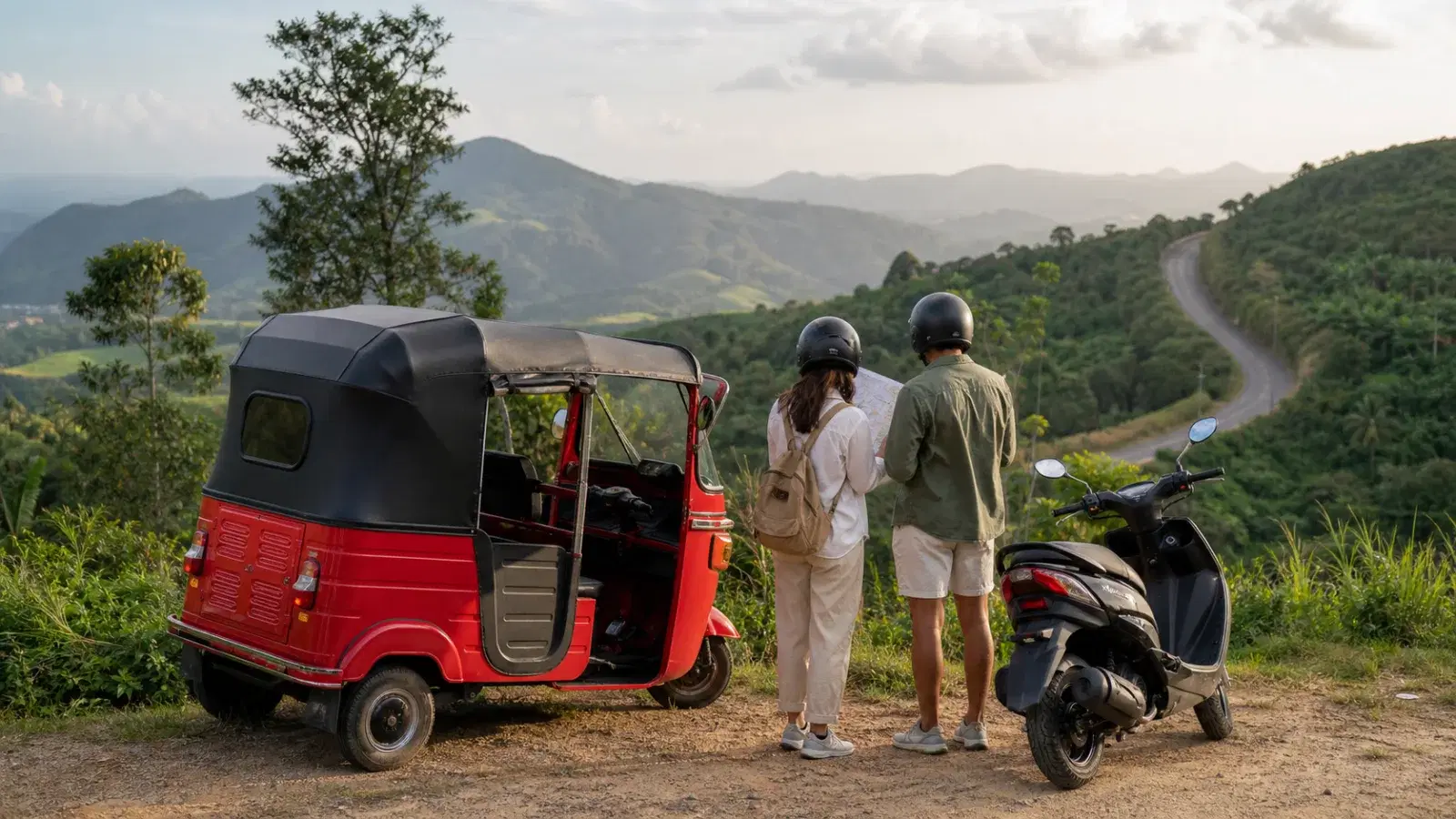
Something has changed in how people travel Sri Lanka. Ten years ago, almost every foreign visitor either hired a driver for their whole trip or moved between towns by train and bus. Today, on any given morning on the road between Ella and Wellawaya, you will pass foreign couples driving their own tuk-tuks, luggage strapped to the back, phone clipped to the windscreen frame.
The appeal is obvious. Sri Lanka is small — you can cross it in a day — but the good stuff is rarely at the bus stop. It is down an unmarked lane, past a tea factory, at a viewpoint with no name. A vehicle of your own turns a fixed itinerary into an open one.
The problem is that the information travelers find when they start researching is a mess. Search 'can I drive in Sri Lanka' and you will get a dozen confident, contradictory answers. One page says an International Driving Permit is all you need. Another says it is worthless. Fees are quoted at LKR 1,000 on one site and LKR 15,000 on another. Almost every one of those pages is published by a company that wants to rent you a vehicle.
This guide is written by people who are not renting you anything. LankaTrip connects travelers with licensed local guides; we do not operate a vehicle fleet, and we do not take a commission on tuk-tuk bookings. That means we can tell you the parts the rental blogs skip — including the situations where we think you should not self-drive at all.
What follows covers the legal position as plainly as we can state it, the three routes to getting a permit, honest 2026 costs, how to assess a rental company without us naming one, the insurance gap that could cost you a five-figure hospital bill, and what Sri Lankan roads genuinely feel like from behind a handlebar.
Kurzüberblick
- Your home licence and an International Driving Permit are NOT enough on their own — Sri Lanka requires a locally issued permit
- Since August 2025 there is a Department of Motor Traffic counter in the arrivals hall at Bandaranaike International Airport, open around the clock
- The airport permit covers cars, motorbikes and scooters — it does NOT cover tuk-tuks
- Tuk-tuks are three-wheelers and need a separate endorsement, usually via the Automobile Association of Ceylon, which now requires an International Driving Permit first
- Published permit fees contradict each other wildly online; budget flexibly and confirm at the counter
- Expect roughly USD 10–22 per day for a tuk-tuk and USD 8–15 per day for a scooter in 2026, plus a refundable deposit
- Most standard travel insurance policies exclude motorised-vehicle accidents unless you buy an add-on AND hold the correct licence
- Sri Lankan police recorded over 1,200 road deaths in the first half of 2026 alone — motorcyclists are among the most vulnerable road users
- Self-driving is superb for confident, experienced drivers and a poor idea for nervous or first-time riders