LankaTrip Einblicke

30 Min. Lesezeit

Colombo Kite Festival 2026: The Complete Guide to Galle Face Green's Sky Season

The Colombo International Kite Festival returns to Galle Face Green on 8 and 9 August 2026. Here is the practical guide for foreign travelers: exact schedule, how to get there around the road closures, what the day is actually like, and how to enjoy Colombo's kite season even if you arrive in a different week.

Zurück zum Blog
Colombo Kite Festival 2026: The Complete Guide to Galle Face Green's Sky Season

Most foreign travelers meet Sri Lanka's festival calendar through its processions. The Kandy Esala Perahera, the temple drums, the caparisoned elephants, the fire dancers. Those are extraordinary, and they are also formal, ticketed, and organised around religious observance.

The Colombo Kite Festival is the opposite kind of event. There is no ritual, no ticket, no seating plan and no dress code. There is a wide public lawn on the edge of the Indian Ocean, a wind that blows in hard off the water for three months of the year, and several hundred thousand people who have decided to spend a Sunday afternoon looking up.

In 2026 the Colombo International Kite Festival is scheduled for Saturday 8 and Sunday 9 August at Galle Face Green. It is the second international edition of an event that began more than a decade ago as a local television project and has since grown into a genuine international gathering, with kite flyers arriving from across five continents to fly alongside Sri Lankan enthusiasts.

This guide is written for travelers who want to actually attend, rather than read a paragraph about it. It covers the confirmed schedule, how to reach Galle Face when the police have closed half the surrounding road network, what the crowd density is genuinely like, and what to carry.

It also covers something almost every other article on this subject leaves out, and it is the single most useful thing on this page: the festival is one weekend, but Colombo's kite season lasts roughly three months. If you are in Sri Lanka in July, or late August, or September, you have not missed anything essential. You can still buy a handmade bamboo-and-paper kite from the person who made it and fly it over the ocean at sunset. That experience is available on most breezy evenings, it costs almost nothing, and for many visitors it is better than the festival day itself.

Kurzüberblick

  • The Colombo International Kite Festival 2026 is scheduled for Saturday 8 and Sunday 9 August at Galle Face Green
  • Saturday opens with a vehicle parade through central Colombo from 9.00 am; Sunday is the main kite day, combined with a public musical concert
  • Entry is free and open to the public, and no ticket or registration is required to watch
  • Extensive road closures and diversions are in force, with roughly 1,000 police officers deployed
  • Colombo's kite season is much longer than the festival itself, running roughly from late June to September on the southwest monsoon wind
  • On any breezy evening outside festival weekend you can buy a handmade kite at Galle Face for a few hundred rupees and fly it yourself
  • Expect heavy crowds, strong sun, very little shade and a real chance of monsoon rain
  • This is a mass local event, not a curated tourist attraction, which is exactly why it is worth attending

What the Colombo Kite Festival Actually Is

The event now known as the Colombo International Kite Festival did not begin as a tourism initiative. It started in 2015 as a segment of a Sri Lankan television programme, grew year after year into the country's largest kite gathering, and was eventually formalised into an international festival organised jointly by the Sri Lanka Tourism Promotion Bureau, a national media network and Sri Lanka Police, under a wider Colombo destination branding project.

The first fully international edition was held at Galle Face Green in August 2025. It brought together 55 international kite flyers representing 25 countries across five continents, flying alongside around 500 Sri Lankan participants. Participating nations included Germany, the Netherlands, Malaysia, Indonesia, China, Thailand, South Korea, Brazil, Tunisia, Turkey, Nepal, India, Singapore, France, Cambodia, Ukraine, Australia and Vietnam, among others.

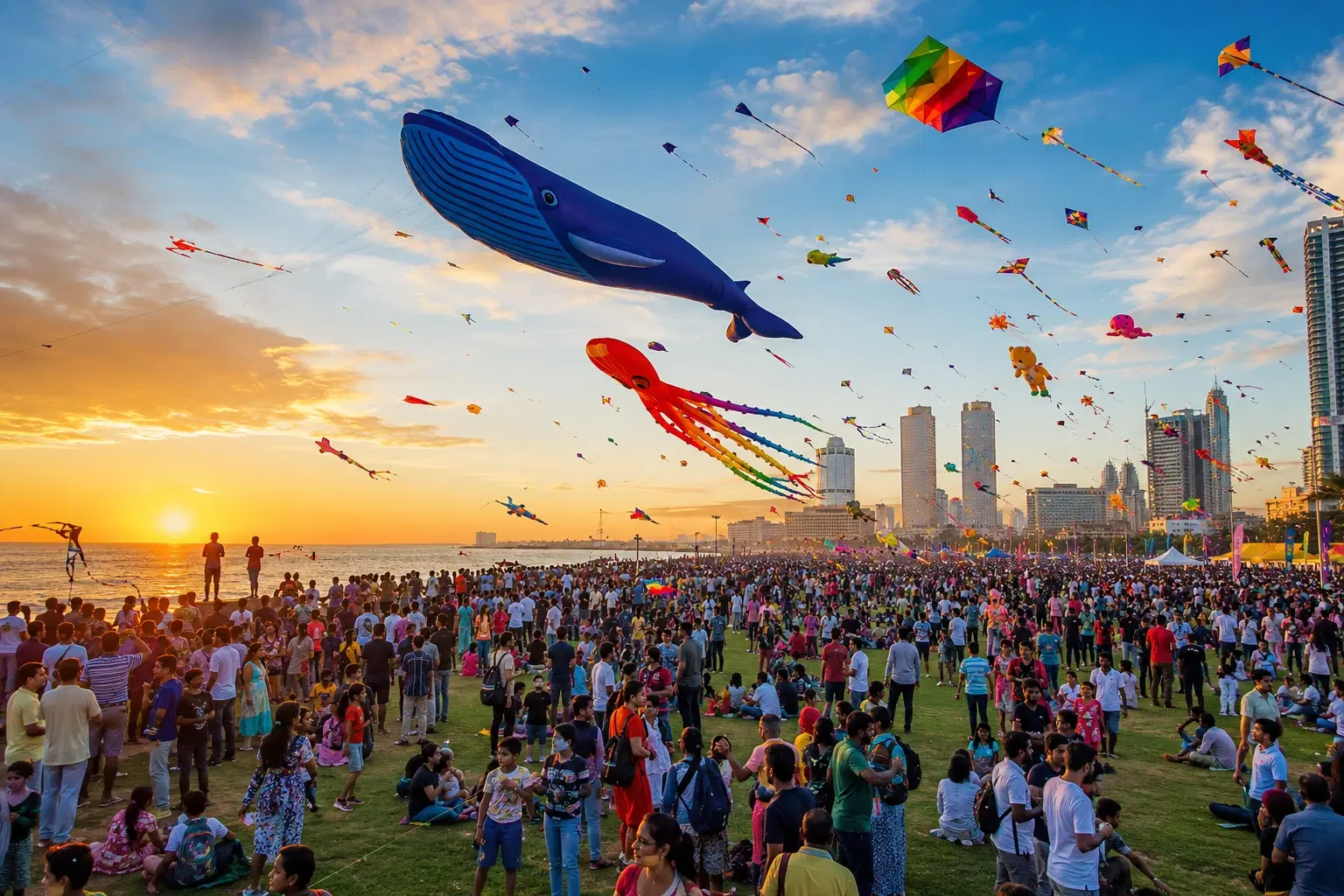
That matters for what you will actually see. This is not only a field of children with diamond kites, although there are thousands of those too. International teams bring the large-format work that defines the global kite circuit: inflatable show kites the size of small buildings, long articulated creatures that undulate for thirty metres downwind, and precision stunt teams flying multi-line kites in synchronised aerobatic routines to music.

The visual result is genuinely unusual. At its peak the sky above Galle Face is layered — small handmade kites at low altitude, mid-level traditional forms, and enormous international show kites anchored high above everything else.

It is worth being clear about the character of the event. This is a free mass-participation public festival attended overwhelmingly by Sri Lankan families. It is loud, informal, crowded and unpolished. Nobody is managing your experience. If you arrive expecting a curated cultural show with assigned viewing areas, you will be disappointed. If you arrive expecting to be absorbed into a genuine local celebration, you will not be.

Began in 2015 as a local television projectFirst international edition held in 202555 international flyers from 25 countries in 2025Organised by Sri Lanka Tourism with a media partner and policeFree, public, and overwhelmingly attended by locals

Colombo Kite Festival 2026: Confirmed Dates and Schedule

The Colombo International Kite Festival 2026 is scheduled to take place at Galle Face Green on Saturday 8 and Sunday 9 August 2026.

The festival opens on Saturday 8 August with a vehicle parade, which begins at 9.00 am and travels through a long route across central Colombo, taking in Colpetty Junction, the Liberty roundabout, Bambalapitiya Junction, Thummulla, Horton Place, the Lipton roundabout, Regal Junction, Lotus Road and Port City. If you happen to be staying anywhere along that corridor, the parade will come to you.

Sunday 9 August is the main day. The kite festival itself and an accompanying musical concert are held at Galle Face Green and are open to the public.

One point that trips up travelers planning ahead: the date moves. The 2025 edition was held on 24 August. The 2026 edition falls on 8-9 August. It is anchored loosely to the monsoon wind season rather than to a fixed calendar date or a lunar observance, and the specific weekend is set by the organisers each year.

Because of that, always reconfirm the schedule close to your travel dates. Sri Lanka Tourism publishes event announcements, and the local English-language news outlets carry the police traffic notice a day or two before the event, which in practice is the most reliable confirmation that it is going ahead as planned.

Timing on the day: kite activity builds through the afternoon and peaks in the two hours before sunset, when the sea breeze is strongest and the light is best. Sunset in Colombo in early August falls around 6.30 pm. Arriving at 3.00 pm gives you the full build-up. Arriving at 5.30 pm means walking a long way through a very dense crowd.

Saturday 8 August 2026: opening vehicle parade from 9.00 amSunday 9 August 2026: main kite festival and musical concertFree entry, no ticket requiredDate changes each year, so always reconfirmPeak activity in the two hours before sunset, around 6.30 pm

The Thing Most Guides Miss: Two Completely Different Experiences

If you take one thing from this guide, take this. There are two entirely separate kite experiences in Colombo, and travel articles routinely blur them into one.

The first is the Colombo International Kite Festival — one weekend, enormous crowds, international teams, a concert stage, road closures, and a scale of spectacle you will not see otherwise.

The second is Colombo's ordinary kite season, which runs roughly from late June through September, driven by the southwest monsoon wind. On any breezy afternoon in that window, Galle Face Green fills with kites. Not thousands of international show kites, but hundreds of handmade ones, flown by families, couples, office workers on their way home and children who have just been handed their first spool of thread.

For a lot of travelers, the second experience is the better one. You can walk up at 5.00 pm on an ordinary Tuesday, buy a kite from a vendor for the price of a coffee, and be flying it over the Indian Ocean within ten minutes. Nobody is jostling you. You can hear the wind. You can sit down when you want to. The people around you are not attending an event, they are just living in their city.

On festival day you will mostly be watching. On an ordinary evening in season you will be participating. Those are different holidays.

The honest recommendation: if your dates happen to overlap the festival weekend, go — the scale is remarkable and it is free. If they do not, do not reschedule your trip around it. Come to Galle Face on any windy evening between late June and September and you will get the part that actually stays with people.

Festival weekend: spectacle, scale, crowds, watchingOrdinary kite season: participation, space, calm, flyingSeason runs roughly late June to SeptemberBoth are freeMissing the festival weekend costs you far less than you would think

Why August, and the Monsoon Paradox Nobody Explains

Colombo's kite season is a direct product of the southwest monsoon, and this creates a contradiction that catches out travelers who have researched Sri Lanka's weather.

Most planning guides will tell you, correctly, that the west and south coasts are in their wet season from roughly May to September, and that the dry, settled months for Colombo are December to March. On that logic, August looks like the wrong time to be standing on an exposed oceanfront lawn.

But the monsoon that brings the rain is also what brings the wind. From late June onward the southwest monsoon drives a strong, consistent onshore breeze straight across Galle Face Green off the Indian Ocean. That is precisely the condition a kite needs, and it is why the kite season and the wet season are the same season.

It also coincides with the long Sri Lankan school holidays in July and August, which is the second half of the explanation for why the entire country appears to be flying kites at this time of year.

In practice this means monsoon rain is a live risk on any given afternoon, including festival day. Colombo's wet-season rain typically arrives as heavy, concentrated downpours rather than all-day drizzle, so a shower often passes within an hour and the flying resumes. But it does mean you should carry rain protection and hold your plans loosely.

It also means the wind can be genuinely strong. On a good day at Galle Face the breeze is enough to take a poorly held kite straight out of a child's hands, and enough to make thin kite thread cut into an unprotected finger. Both are normal parts of the day, and both are worth knowing in advance.

Kite season is created by the southwest monsoon windThe wet season and the kite season are the same seasonCoincides with July-August school holidaysRain usually arrives in short heavy bursts, not all-day drizzleWind can be strong enough to be a genuine hazard

Understanding Galle Face Green Before You Arrive

Galle Face Green is a long strip of open lawn running along the ocean between Colombo Fort and Kollupitiya, bordered on one side by a sea wall and on the other by a main road. It is Colombo's largest public open space and it functions as the city's shared front garden.

It is not a park in the manicured European sense. There is no entrance, no ticket, no closing time and very little planting. The grass is worn in patches, the sea wall is concrete, and much of the surface is open and exposed. This is a feature, not a failing — the reason it works for kites is precisely that there is nothing overhead to catch a line.

There is almost no natural shade. On a clear August afternoon the combination of equatorial sun, reflected glare off the water and no shelter is more demanding than most visitors expect. Plan for it.

The eastern edge of the Green, along the road, is where the informal food economy sets up in the late afternoon: carts and stalls selling grilled and fried street snacks, fresh fruit, sweet drinks and the deep-fried prawn fritters that most Sri Lankans associate with this specific place. On festival day this expands into a continuous line.

Public toilets exist near the Green but are limited relative to festival-day crowds, and the queues become long. Use facilities before you arrive, particularly if you are travelling with children.

The Green is generally safe and busy well into the evening, and it is one of the more comfortable places in Colombo for a solo traveler or a woman travelling alone to spend an evening, precisely because it is so heavily used by families.

Free, open, ungated public oceanfront lawnNo natural shade anywhere on the GreenStreet food concentrated along the road edgeLimited public toilets for festival-day numbersBusy and family-dominated well into the evening

Getting There Around the Road Closures

This is where festival-day planning matters most. For the 2026 edition, Sri Lanka Police have announced extensive traffic and parking arrangements, with approximately 1,000 officers deployed, including around 300 traffic officers.

During Saturday's opening parade, motorists are advised to avoid the parade route entirely — Colpetty Junction, the Liberty roundabout, Bambalapitiya Junction, Thummulla, Horton Place, the Lipton roundabout, Regal Junction, Lotus Road and the Port City area — and to use alternative roads. Congestion is expected along the whole corridor.

Restrictions and diversions on and around festival day affect a broad set of central streets in the Fort and Slave Island area, including roads immediately behind Galle Face. Designated paid parking is arranged at several car parks around Union Place, the Gamini roundabout area, and the Fort, but these fill early and are not close to the Green.

The practical conclusion for a visitor: do not plan to be driven to the entrance. There is no entrance, and the roads nearest the Green will be either closed or gridlocked.

The best approach is to get within roughly a kilometre and walk the rest. Coming from the south along the coast, Kollupitiya is the natural approach on foot. Coming from the north or east, walk in from the Fort side.

Trains are the one form of transport that ignores road closures entirely. Colombo's coastal railway line runs parallel to the shore, and Kollupitiya station sits a short walk south of the Green, with Colombo Fort station a longer walk to the north. On a congested festival Sunday, a short coastal train hop from Mount Lavinia, Dehiwala or Bambalapitiya is often dramatically faster than any road option. Trains are cheap, frequent on this stretch, and will be very full.

Ride-hailing apps work normally in Colombo, but expect surge pricing, long pickup times and drivers unable to reach the pin. Agree a drop-off point well back from the Green rather than at it, and expect the return journey after the concert to be the hardest part of the day. Walking ten or fifteen minutes away from the crowd before requesting a ride will usually save you more time than waiting where you are.

If you are staying in central Colombo, walking both ways is genuinely the best option and avoids the entire problem.

Around 1,000 police officers deployed on festival daysWide road closures across Fort, Slave Island and the parade routeDo not plan a door-to-door drop-offCoastal trains bypass road congestion entirelyWalk 10-15 minutes clear of the crowd before booking a ride home

What Festival Day Is Actually Like

Arrive in the early-to-mid afternoon and the Green is busy but navigable. There is space to sit, the wind is picking up, and international teams are setting up large kites along the seaward side.

By late afternoon the density changes character completely. Past editions of this event have drawn crowds in the hundreds of thousands, and on the main Sunday the lawn stops being a space you move through freely and becomes a space you move through slowly.

The sensory experience at peak is worth describing honestly, because it is the point. Overhead there is a genuinely dense layer of colour — traditional diamonds, long-tailed serpents, birds, bats, fish, cartoon characters, and above them the international show kites. At ground level there is music from the concert stage, competing sound from vendor carts, the smell of frying, and a constant crosstalk of people negotiating string and space. It is chaotic and it is very good-natured.

The concert element on Sunday draws its own crowd, some of whom come for the music rather than the kites, and this thickens the density near the stage considerably after dark.

What it is not: it is not quiet, it is not organised for spectators, and there are no vantage points, grandstands or reserved areas for visitors. There is no viewing platform. What you see depends on where you happen to be standing, and the sky is the same sky from anywhere on the Green — which is the one real advantage of a kite festival over a procession.

Because of that, resist the instinct to push toward the centre. The best position for a foreign visitor is usually toward the outer edges of the Green, or on the elevated sea wall, where you get the same view of the sky with a fraction of the crush and a clear exit.

Crowds have reached the hundreds of thousands in past editionsPeak density in the two hours before and after sunsetNo grandstands, viewing platforms or reserved areasThe sky looks the same from anywhere, so stay on the edgesThe sea wall offers elevation and an easy exit

What to Bring, and What to Leave at Your Accommodation

Sun protection first, and take this more seriously than you would at home. There is no shade on Galle Face Green, the sun is close to overhead, and the glare off the ocean effectively doubles the exposure. High-factor sunscreen, a hat that will stay on in strong wind, and sunglasses.

Water. Vendors sell drinks, but on festival day queues are long and prices rise. Carry more than you think you need, particularly for children.

Rain protection. A compact poncho or light rain jacket packs smaller than an umbrella and is far more practical in a dense crowd and a strong onshore wind, where umbrellas are close to useless.

Closed shoes rather than sandals. The ground is uneven, the crowd is dense, and there is broken shell and grit along the sea wall edge.

Cash in small denominations. Street vendors, tuk-tuks and small stalls are cash-first, and small notes make everything faster. Card acceptance at informal stalls should not be assumed.

A crossbody bag worn at the front, not a backpack. This is standard crowd sense anywhere in the world and applies here.

Leave behind: anything valuable you would be upset to lose, and any expectation of using a drone. Drone operation in Sri Lanka requires prior approval from the Civil Aviation Authority, and a mass public event with an active airspace full of kite lines and a heavy police presence is not a place to test that. Assume drones are prohibited.

If you are bringing children, agree a meeting point before you enter the crowd and write your phone number on their arm or a card in their pocket. In a crowd this size, on grass, with everyone looking up rather than around, children separate from parents easily and quickly.

High-factor sunscreen, secure hat, sunglassesMore water than you think you needPoncho rather than umbrellaClosed shoes and a front-worn crossbody bagSmall-denomination cashAssume drones are not permittedAgree a meeting point with children before entering the crowd

Buying and Flying Your Own Kite

Watching is fine. Flying is better, and it is the single cheapest memorable thing you can do in Colombo.

Kites are sold along the road edge of Galle Face Green throughout the season by vendors who, in many cases, made them by hand. These are traditional constructions: a bamboo or coconut-frond frame, coloured tissue paper or light cloth, glue and thread. A well-made one takes a couple of hours to build.

Prices are modest — typically a few hundred to a couple of thousand rupees depending on size and complexity, though this shifts with materials and season. Buy the thread with the kite; a kite without a properly wound spool is frustrating rather than fun.

Buying directly from a maker rather than a general shop matters more than it sounds. Kite making in Sri Lanka is often a multi-generational family craft, and the three-month season is when that craft earns. It is a rare case where the tourist purchase and the local benefit line up perfectly.

On technique, the Galle Face wind does most of the work. Stand with your back to the sea, have someone hold the kite up and downwind of you, let out an arm's length of thread, and pull sharply. If it climbs, feed thread out steadily. If it dives, let the thread go slack rather than pulling harder. Local children will correct you within about ninety seconds, usually with great enthusiasm, and this is one of the easier ways to end up in conversation with people.

Two safety notes. Kite thread under tension cuts skin — wrap it around a spool or a stick rather than around bare fingers, and never around your neck or wrist. And never fly near overhead power lines, which is why the open middle of the Green is the right place and the road edge is not.

If you are buying a kite as a souvenir rather than to fly, the paper ones do not travel well. Ask for a cloth kite or a folding design if it needs to survive a suitcase.

Handmade kites sold along the road edge of the GreenTypically a few hundred to a couple of thousand rupeesBuy the thread and spool with the kiteBuying from makers supports a multi-generational craftNever wrap kite thread around bare fingers, neck or wristStay well clear of overhead power lines

Sri Lankan Kite Culture: More Than a Weekend Event

The Sinhala word for kite is sarungalaya, and kite flying here is old enough that its origins are not documented. Unlike many Sri Lankan traditions, there is no clear textual record of when or how kites arrived on the island, no founding reference in the chronicles, and no settled account of where the word itself came from.

What is well established is how deeply the practice is embedded. It is not a festival activity that people take up for one weekend. Between July and September, kites appear over paddy fields, village playing fields, urban rooftops and every open beach on the island. Colombo has the largest concentration because it has the largest open space and the most reliable wind, but the season is national.

Certain forms recur. The plain diamond is the beginner's kite. The wawula, a bat-shaped kite, is one of the most recognisably Sri Lankan designs and remains popular decades after it was first made. Beyond those, the tradition is enthusiastically unbound — anything that flies is fair, which is why the sky at Galle Face contains dragons, fish, starfish, snakes with thirty-foot tails and a fair number of cartoon characters.

There is a symbolic layer as well. Kites are widely associated with good fortune and prosperity, and in some interpretations they are understood to carry wishes and prayers upward. It is a light association rather than a formal religious one — nobody at Galle Face is performing a rite — but it is part of why the image of a kite recurs across Sri Lankan visual culture.

Kite flying has also carried a social meaning at particular moments in the country's recent history. In the years after the civil war, kite festivals were organised in the north as deliberate gestures of reconciliation between communities and between civilians and the security forces. It was an unusually well-chosen symbol: something that costs almost nothing, requires open shared ground, and only works when the sky is empty of everything else.

That history is worth carrying with you at Galle Face. The scale of the crowd, and the fact that this crowd is Sinhala, Tamil, Muslim and Burgher standing on the same grass looking at the same sky, is not incidental to what the event has come to represent.

Sarungalaya is the Sinhala word for kiteOrigins are undocumented in Sri Lankan historical recordsThe bat-shaped wawula is a signature local formKites associated with good fortune and carrying wishesPost-war kite festivals used as reconciliation gestures in the north

Photographing the Kite Festival

This is a difficult subject that looks easy, and most visitors come away with a phone full of pale blue rectangles containing small specks.

The core problem is that kites are small, distant and lit from behind against a bright sky. Metering for the sky underexposes the kite; metering for the kite blows out the sky.

The practical fixes: shoot in the last ninety minutes before sunset, when the sun is low enough to light the kites from the side rather than from behind and the sky has colour in it. Frame kites against clouds, the ocean horizon or the Colombo skyline rather than against empty blue, so there is something to give scale. And include people — a child holding a spool with the kite far above is a far better photograph than the kite alone.

For phone cameras, tap to expose on the kite and then pull the exposure slider down slightly to recover the sky. Avoid digital zoom, which turns a small kite into a small blurry kite; walk closer to the flyer instead.

The strongest single frame available at this event is usually silhouette: get low, shoot toward the setting sun over the Indian Ocean, and let the kites, the lines and the people all go dark against the colour.

On courtesy: this is a crowd of families, not performers. Wide shots of the sky and the crowd are unproblematic. Close portraits of individuals, particularly children, need a smile and a gesture toward the camera first. Sri Lankans are generally warm about this, and asking costs you nothing.

Salt spray and fine grit blow across the Green on a strong monsoon wind. Change lenses as little as possible, and wipe the front element before you shoot rather than after.

Shoot in the last 90 minutes before sunsetFrame kites against clouds, ocean or skyline, not empty blueInclude people for scaleSilhouette into the sunset is the strongest reliable shotAsk before close portraits, especially of childrenProtect gear from salt spray and blown grit

The Honest Downsides

Crowd density is the main one. On the peak Sunday, movement across the Green slows to a shuffle in places, and if you are claustrophobic, mobility-limited, or travelling with a toddler in a pushchair, the middle of the Green after 5.00 pm is not a comfortable place to be. The edges and the sea wall are.

Heat and sun exposure cause more problems at this event than anything else. There is no shade, the afternoon is hot and humid, and a lot of visitors underestimate a few hours of standing in it. If you start to feel light-headed, move to the shade of a building on the road side and drink water rather than pushing through.

Opportunistic theft occurs, as in any large crowd anywhere. Violent crime at this event is not a realistic concern; a phone lifted from a back pocket while you are looking up is. Front-worn bag, phone in a zipped pocket, and that is the end of the problem.

Street food is a genuine part of the experience and most visitors eat it without incident, but the usual caution applies more strongly on a day with this volume: prefer items cooked to order in front of you and served hot, be more careful with anything that has been sitting out, and avoid drinks with ice from informal carts if you have a sensitive stomach.

Rain can end the flying abruptly. It usually passes, but there is no shelter on the Green, and the walk to cover is not short from the middle.

Note also that Nikini Poya falls on 27 August 2026, later in the same month. On Poya full-moon days across Sri Lanka, the sale of alcohol is prohibited and many establishments close or restrict service. This does not affect the kite festival weekend itself, but it is worth knowing if you are planning the rest of your August around it.

And a note on expectations: the international show kites are the headline, but they are dependent on wind. If the breeze is weak on the day, the large-format kites stay grounded and what you get is a very large crowd and a modest sky. That is the risk with any outdoor wind-dependent event and it cannot be planned around.

Extreme crowd density at peak; stay on the edgesNo shade — sun and heat are the most common problemOpportunistic pickpocketing in crowds; front-worn bagPrefer street food cooked to order and served hotNikini Poya on 27 August 2026 brings island-wide alcohol restrictionsWeak wind can ground the large show kites entirely

Building a Colombo Day Around the Festival

Galle Face sits at the edge of the most walkable part of Colombo, which makes the festival easy to combine with a broader day in the city rather than treating it as a standalone trip.

A morning in the Fort quarter works well before the crowds build. The colonial-era commercial district immediately north of the Green holds Colombo's densest concentration of Dutch and British architecture, and it is quiet on a Sunday morning.

The Pettah market district, further east, is the opposite experience — a dense, loud, entirely functional wholesale bazaar. It is at its most intense on weekday mornings and considerably calmer on Sundays, which suits a festival day.

Colombo's National Museum and the Gangaramaya and Seema Malaka temple complex around Beira Lake are both within reasonable reach and both give a cooler, quieter contrast to an afternoon in the open sun.

For food, the practical move on festival day is to eat properly at lunch somewhere indoors and treat the Galle Face street food as snacking rather than as your meal. Queues at peak are long and the seating is a patch of grass.

After the concert, the return journey is the crux of the day. If you are staying centrally, walk. If not, walk clear of the crowd first and book from a quieter street. Colombo's after-dark rhythm and the practicalities of moving around the city at night are covered in more depth in our Colombo nightlife guide.

If you have a few days, the festival also slots neatly into a wider west-coast plan, since Colombo is the natural arrival and departure point for most itineraries and August suits the east and north far better than the south.

Fort quarter is quiet and walkable on a Sunday morningPettah market is calmer on Sundays than weekdaysNational Museum and Beira Lake temples for shade and quietEat a proper indoor lunch; treat Galle Face food as snackingWalk clear of the crowd before booking a ride home

If You Miss the Festival Weekend

You have not missed the experience. You have missed one version of it.

Between roughly late June and September, come to Galle Face Green on any afternoon when the wind is up, from about 4.00 pm onward. Buy a kite. Fly it. Watch the sun go into the Indian Ocean. It costs a few hundred rupees and about two hours, and a significant number of travelers rate it above the festival day itself.

Weekends and public holidays during the season are busier and livelier than weekdays, without approaching festival density. A Sunday evening in late July or early September is close to the ideal balance.

Outside Colombo, the same monsoon wind produces kite flying on open ground across the country during the season. Beaches on the west coast, and open fields inland, fill with kites through the school holidays. It is a national habit, not a Colombo one.

The east coast is a special case in this window. From roughly May to September the east is in its dry season while the west is wet, so beaches around Trincomalee, Nilaveli and Pasikuda offer steady coastal wind with far better weather than Colombo. If your August plan is flexible, that is where the rest of the month belongs.

And if you are planning a future trip specifically around the festival: watch for the announcement in June or July, expect a date somewhere in August, and do not book non-refundable arrangements around an unconfirmed date. It has moved every year.

Kite season runs roughly late June to SeptemberArrive at Galle Face from around 4.00 pm on a windy dayWeekends in season are lively without festival crowdsKite flying happens nationwide, not only in ColomboThe east coast is in dry season during the same months

Reisetipps

  • Reconfirm the festival date close to your travel dates, because it moves every year
  • Arrive by mid-afternoon rather than at sunset to avoid walking through peak crowd density
  • There is no shade on Galle Face Green, so treat sun protection as essential rather than optional
  • Carry more water than you expect to need, particularly with children
  • Use the coastal railway to bypass road closures on festival day
  • Do not plan a door-to-door drop-off; walk the last kilometre
  • Walk well clear of the crowd before booking a ride home
  • Stay on the outer edges or the sea wall, where the sky looks the same and the crush is far less
  • Carry small-denomination cash for vendors, stalls and tuk-tuks
  • Wear a crossbody bag at the front and keep your phone in a zipped pocket
  • A poncho beats an umbrella in a strong onshore monsoon wind
  • Never wrap kite thread around bare fingers, wrist or neck
  • Assume drones are not permitted; drone use in Sri Lanka requires Civil Aviation Authority approval
  • Agree a meeting point with children before entering the crowd
  • Buy kites directly from the makers along the road edge rather than from general shops

Häufige Fragen

When is the Colombo Kite Festival 2026?

The Colombo International Kite Festival 2026 is scheduled for Saturday 8 and Sunday 9 August 2026 at Galle Face Green, Colombo. Saturday opens with a vehicle parade through central Colombo from 9.00 am, and Sunday is the main kite day, held together with a public musical concert. The date changes each year, so reconfirm close to your travel dates.

Is the Colombo Kite Festival free?

Yes. Galle Face Green is ungated public parkland and the festival is free and open to the public. No ticket, booking or registration is required to attend or to watch.

Where exactly is the Colombo Kite Festival held?

At Galle Face Green, a long oceanfront lawn in central Colombo between the Fort district and Kollupitiya. There is no single entrance, since the Green is open public space bordered by a main road on one side and the sea wall on the other.

How do I get to Galle Face Green on festival day?

Extensive road closures and diversions are in force, so avoid planning a direct drop-off. The coastal railway line is the most reliable option, with Kollupitiya station a short walk south of the Green and Colombo Fort station to the north. Otherwise, get within about a kilometre by road and walk the rest.

How crowded does it get?

Very. Past editions have drawn crowds in the hundreds of thousands, with peak density in the two hours around sunset on the main Sunday. Because the attraction is in the sky, you lose nothing by staying on the outer edges of the Green or on the sea wall, which is far more comfortable.

Can I fly my own kite at the festival?

Yes. Handmade kites are sold by vendors along the road edge of Galle Face Green, typically for a few hundred to a couple of thousand rupees including thread. On festival day space is limited, so many visitors find it more enjoyable to fly on an ordinary evening during the season instead.

What if I am in Sri Lanka but not on the festival weekend?

You have not missed much of what matters. Colombo's kite season runs roughly from late June to September on the southwest monsoon wind, and Galle Face Green fills with kites on most breezy afternoons in that window. Many travelers prefer an ordinary evening, when there is space to actually fly a kite yourself.

Is the Colombo Kite Festival suitable for children?

Yes, and it is overwhelmingly attended by local families. That said, the crowd on the main day is dense, there is no shade, and children separate from parents easily when everyone is looking upward. Agree a meeting point in advance and consider the calmer outer edges of the Green with young children.

Will monsoon rain ruin it?

It might interrupt it. Early August is within the southwest monsoon on Sri Lanka's west coast, and the same wind that makes kite flying possible also brings rain. Colombo's wet-season rain usually arrives as short heavy downpours rather than continuous drizzle, so activity often resumes within the hour, but there is no shelter on the Green.

Can I fly a drone at the kite festival?

Assume not. Drone operation in Sri Lanka requires prior approval from the Civil Aviation Authority, and a mass public event with airspace full of kite lines and a heavy police presence is not somewhere to attempt it.

Is Galle Face Green safe at night?

It is one of Colombo's busiest and most family-dominated public spaces, and it stays lively well into the evening, including for solo travelers. As in any large crowd, opportunistic pickpocketing is the realistic concern rather than anything more serious, so keep valuables secured and worn at the front.

How long has the Colombo Kite Festival been running?

It began in 2015 as a segment of a Sri Lankan television programme and grew into the country's largest kite gathering. The first fully international edition was held at Galle Face Green in August 2025, bringing 55 international kite flyers from 25 countries together with around 500 Sri Lankan participants.

Leser-Notizen

Mach mit beim Gespräch

Teile deine Frage, deinen Tipp oder deine Reiseerfahrung zu diesem Guide.

Kommentare

0 Kommentare

Wird geladen...

Bereit, Inspiration in eine Sri-Lanka-Reise zu verwandeln?

Nutze LankaTrip, um deine Reise zu planen, lokale Guides zu finden und diese Route Wirklichkeit werden zu lassen.

Hilfe bei der Planung?

Plane dein Sri-Lanka-Abenteuer

Reise planen